

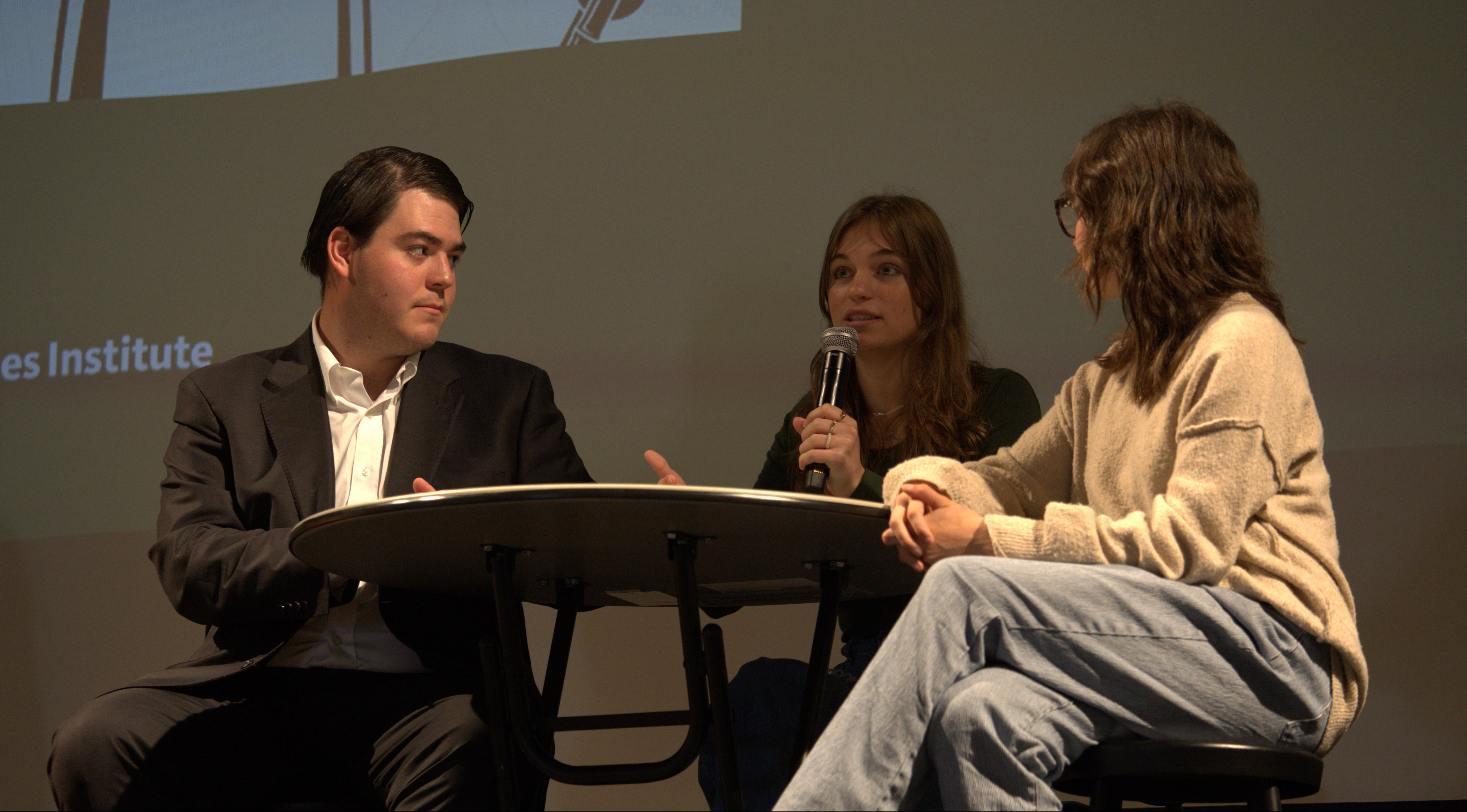


On the first day of my Reporting I class in January, Instructor Charlie Deitz introduced himself and wrote two OOCs on the board. “Outside-of-class opportunities,” he called them.
One of those opportunities involved interviewing immigrants about how they get their news and then presenting the findings at the Extra! Extra! Don’t Kill the Messenger Symposium at the UO School of Journalism and Communication (SOJC) in April.
As a daughter of immigrants, my ears perked up. Going out and talking to immigrants, creating an audio compilation of their insights and presenting them to a group of journalists? “What an opportunity!” I thought to myself.
“If anyone’s interested…,” Deitz started saying. My hand shot up. “Put your hands down and send me an email,” he finished.
I sent the email before the class period ended.
I went into this assignment hoping to get more experience with interviewing and audio production. I wanted to shine a brighter light on immigrant issues and show people the stories of immigrant struggles that I heard growing up. I didn’t expect to learn so much more about the lives of immigrants and the importance of journalism for people from other countries. I also learned valuable lessons about putting myself out there, having difficult conversations and trusting myself and my work.
I was ecstatic to have been accepted to work on the project. There were three months until April, so I wasn’t worried. And then I blinked, and it was March. “Your interviews should be done by the end of spring break,” Deitz told us. I think he saw the terror in my face.
I rushed to call Latino-American organizations in Eugene and Spanish-speaking churches in Portland in case I’d have to do interviews over break.
A pastor put me in contact with my first source, Mary Avalos from Mazatlan Sinaloa, Mexico. My mom worked with Daphne Alvaréz from Bucaramanga, Santander, Colombia, who became my second source. After I asked her if she knew anyone else I could talk to, Alvaréz put me in touch with Ana Claudia Mariño Cortés, my third and last source. She was from Santiago, Chile.
I interviewed Avalos and Mariño Cortés in Spanish, since they felt more comfortable and confident responding in their native language. Luckily, I speak Spanish. Unluckily for them, I hadn’t spoken Spanish in six years. Their patience was admirable.
I wrote down questions about where they got their news, how they felt it represented them, what they wished they saw more of, whether they thought American news or the news from their country was reliable. I thought I knew what their answers would be, and I thought I knew the depth the interviews would go to. But I had no idea.
Establishing empathy

Avalos was my first interview.
“So, how did you end up in the U.S.?” I asked.
For the next 10 minutes, she broke down every point of her immigration journey. She spoke about the inheritance she had waiting for her, which she never received. She told me about couch-surfing and how she had gotten stuck in an abusive situation, was held against her will and was forced to escape. She told me about the two women — “angels,” as she referred to them — who helped her get her residency. And she talked a lot about forgiveness, gratitude and faith.
I teared up a few times.
News shouldn’t have to be pessimistic

Mariño Cortés had more critiques than praise. She felt the news focused only on Chilean criminals, never immigrants who came to the United States to work. Her experience coming to the U.S. was much easier than that of Avalos. She was grateful to be here. She felt safer. In Chile, she said, “I wouldn’t be able to sit here with you with my phone out on the table, and my earrings in and my watch on.”
She wanted to see more good news, she told me. It made her sad to see how pessimistic journalism was, both in Chile and America. Crime and drugs existed in the country, yes. But, she said, “It’s just another country to live in, just the same as the U.S.” There’s good and there’s bad, she said. Why settle for the bad?
Ignoring an audience of immigrants
I talked to Alvaréz for an hour. “I hope you don’t have any food allergies,” she said, pulling an empanada and cheese bread from a nearby Colombian food cart out of her bag. She also brought me handouts of articles. One was titled, “Can U.S. journalism truly serve global audiences? Not if it treats them like an afterthought.”
She spoke about her experience being stereotyped as an immigrant because of the news’ portrayal of Colombians. She talked about how American journalism doesn’t include immigrants in the audience of their stories on global issues. “We have a lot to offer,” she said.
I spent three hours transcribing the interviews, another three creating the audio project and another three wondering if my audio project was terrible. I had emailed back and forth with Deitz trying to find an outline or structure to follow, but he trusted me more than I trusted myself.
Finally, presentation day was around the corner. I was nervous and shaky. I misspoke and choked on my words. But overall, it was the most rewarding experience of my life. I was proud to talk about the incredible women I spoke to, and privileged to have been a part of this project. And it was an honor to put them at the forefront of the story.
 Julia Boboc
Leave a comment